
Thursday, 1 March 2012


Tuesday, 28 February 2012

Life Drawing -


Playing with perspective and for-shortening, took a while to get to grips with the idea of it as it felt so unnatural
Film Review – Hitchcocks Rear Window
 |
| Fig.1 Poster Art |
Rear Window is a Alfred Hitchcock movie released in 1954
based on Cornell Woolrich’s 1942 short
story “It had to be Murder”. It’s an American suspense film starring James
Stewart, Grace Kelly, Wendell Corey and Thelma Ritter. Critics and scholars
claim ‘Rear Window’ is Hitchcock’s
best, receiving four Academy Award nominations.
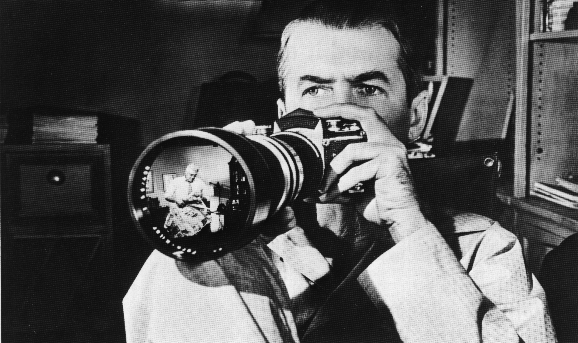 |
| Fig.2 Telescopic Camera |
Jeff (James Stewart) is confined to his apartment with a
broken leg; his rear window looks out onto a small courtyard and several other
compartments. During an extremely hot summer he spends his time by watching his
neighbours. He notices suspicious movements from a certain neighbour who
travels back and forth from his apartment with suitcases, soon after the disappearance
of wife. Jeff and his partner Lisa Fremont (Grace Kelly) become increasingly weary
about the situation and begin to make further inquiries.
The build up of suspense during this film can only be down
to “Hitchcock's supple and witty handling
of a story that only slowly develops true tension lends the proceedings a
complete sense of confidence” (MCCARTHY, 2000) The way that Hitchcock
builds up the pace to the final un-ravelling of the plot makes for a very
enjoyable watch, as nearly every other Hitchcock film achieves and “In a very general way, it effortlessly
demonstrates all that we now understand to be the splendour of the Hitchcockian
cinema of the absurdly logical.” (CANBY, 1983)
 |
| Fig.3 His front row seat to a real-time drama |
“Rear Window is
a demonstration that the spectator identifies with the camera, and that the
entire cinema machine is predicated on what psychologists call the scopic
drive.” (Hoberman, 2000) The viewer is made to feel as if he is staring
through the keyhole into other people’s lives as they play out, this is exactly
what Hitchcock wanted to achieve through this movie.
The film leads the viewer to wonder what is really going on
in the lives of our own neighbours, and what secrets lie in closet of them, as
Jeff’s home-care nurse says during the film "Whatever
happened to that old saying, 'Love thy neighbour'?".
Bibliography
List of Illustrations
Fig.1 http://upload.wikimedia.org/wikipedia/en/thumb/d/d6/Rearwindowposter.jpg/220px-Rearwindowposter.jpg
Fig.2 http://hitchcock.tv/mov/rear_window/images/window2.gif
Fig.3 http://andrewsidea.files.wordpress.com/2010/03/rearwindow2.png
Friday, 24 February 2012
Film Review – Alfred Hitchcock – Psycho
 |
| Fig.1 Poster Art |
Psycho, released in 1960 is a suspense/ horror film directed
by Alfred Hitchcock based on the novel by Robert Bloch, which is inspired by
the Wisconsin murderer and grave robber Ed Gein. The film received mixed
reviews, however due to its smash hit at the box office, which led to four
Academy Award nominations was re-reviewed by many and since then has been a
turning point in the film industry in terms of the use of editing and its
story.
The follows the secretary Marion Crane (Janet Leigh) who steals
$40,000 from a client of her employer, and flees to her lover in California Sam
Loomis (John Gavin) There is a heavy rainstorm on route, forcing her to stay at
a Bates motel until the storm has stopped. The owner seems nice enough, just
appears a little lonely to Marion.
 |
| Fig2. Shower scene |
The Atmosphere created throughout this film is second to
none, with one of the most famous scenes constantly parodied in future films,
the shower scene with Marion. “brilliantly
economical and tense, are simply more psychologically convincing and real than
anything else in this baroque, inspired shocker” (Peter Bradshaw,
2010) the quick camera movements and editing within the shower scene involves
the viewer almost totally, making one feel as if he is the attacker or the
victim. The montage editing, flicking back and forth from the knife to the face
of Marion. “The
famous shower scene never shows the knife touching flesh, but it's still
terrifying.” (Wenk 2011)The attack comes what unexpected to the viewer, making
us feel deeply for the death of her. Once this attack has happened the viewer
knows that the film is about to fall into chaos.
 |
| Add caption |
The film has become one of the most overly critiqued movies “And, of course, it was the first movie to show a toilet
flushing, so we might also credit it with spawning the entire gross-out genre.
‘Psycho’: we salute you.” (David Jenkins, 2010) The film opened many people’s
eyes to what film could become in the future.
Release:
1960
Director:
Alfred Hitchcock
Screenplay by:
Joseph Stefano
Produced by:
Alfred Hitchcock
Genre/subgenre:
Thriller, Mystery, Horror
Country:
United States
Cast:
Anthony Perkins, Vera Miles, John Gavin, Martin Balsam, John McIntire,
Janet Leigh
Bibliography
List of Illustrations
Fig 1: http://upload.wikimedia.org/wikipedia/en/thumb/b/b9/Psycho_(1960).jpg/215px-Psycho_(1960).jpg
Fig 2: http://www.weeatfilms.com/wp-content/uploads/2012/01/1960-PSYCHO-0011.jpeg
Fig.3: http://filmsdefrance.com/img/Psycho_2.jpg
Thursday, 23 February 2012
After receiving feedback from my OGR it became clear that
you would not fully understand the how the characters came to be where they
were, and how their rivalry would really show, so from Phil’s feedback I have
re-wrote act 1 so that it is more simple however easier to see.
Act 1 –
Environment – Inside Geoffrey’s trailer
Time - Night
FADE IN:
Geoffrey sits at his desk chair, reclining with his eyes
closed but still awake. In the corner of the room a small Victorian stool sits
with a vintage vinyl player playing soft jazz playing.
The walls of the caravan are littered with posters and
framed images of Geoffrey, in his ‘Glory days’ all surrounding the mirror which
sits above his desk which he sitting at.
Geoffrey slowly gets to his feet as his act is announced
over the tannoy outside his caravan.
He admires his self in the mirror with a
sense of defeat in his face, but still a spark of pride and happiness. He gazes
around the caravan as he admires his life work; he drags himself over to the
vinyl player and removes the pin. He walks to the door and places his hand on
the handle, then pausing to look over his shoulder around him.
Then swings the door open with a sigh
CUT TO:
Patrice is stepping out of his caravan at the same time; he
spins quickly on the spot to come face with geoffey.
story-boards incoming :)
.
Monday, 13 February 2012
Saturday, 11 February 2012


Subscribe to:
Posts (Atom)